Finish
To finish something is an anticipated action. Because of this, it can also be an anxiety-inducing process. To finish is to end something, sometimes in a very final or severe way, such as to finish living or, more pop culturally, to execute a finishing move in a combat game. A finish is an end–or at least a boundary. Crossing a finish line ends the journey. It divides the now from the what-will-be-after.
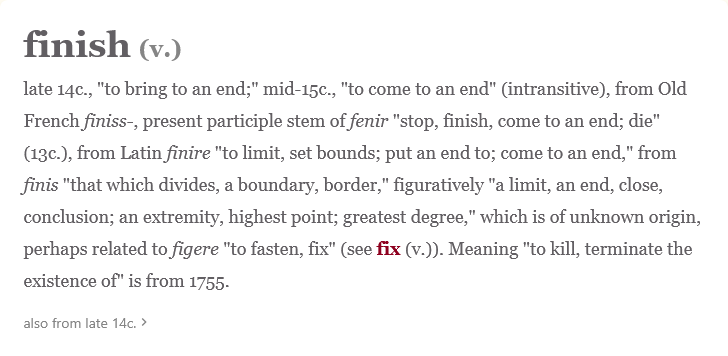
To finish something is also usually intense. It can mark an extreme–the highest or greatest achievement or point. A finish fixes something down in the record: athletes simultaneously breaking and setting records, mountain climbers setting out to summit all the greatest mountains around the world. The finish is a closing of potential, of opportunity, of the now as it becomes an after. After the race, after the summit, after the previous limit of human capability was surpassed by a new limit. Finishes are beautiful and precise because they so perfectly slot into the human instinct to narrativize existence. A finish closes a story tidily and we humans live on stories: stories about ourselves, about our societies, about our world, about each other. Stories make sense to us, so finishes do too. To finish is to "perfect in form or quality," but most of all, it is to complete. The finish becomes inevitable and inescapable in retrospect.
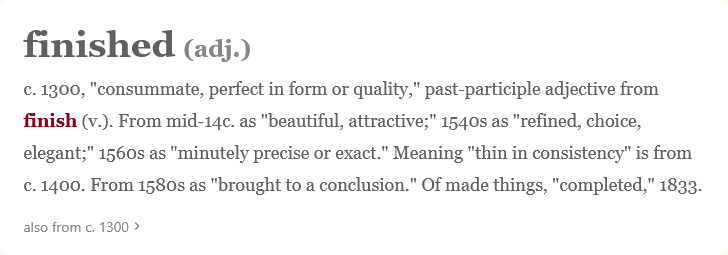
From before the finish, though, that certainty is absent. As someone who struggles with starting tasks and then struggles with ending them for fear they won’t be perfect or as I expect (which is usually as close to perfect as a person could achieve), I often am intimidated by the notion of the finished something being a disappointment. Once it is finished that is the greatest it will be. Sure I could redo it, but then it would be something new–a new potential for disappointment or disaster.
There are some tasks for which there are no permanent finish lines that mark completion. Cleaning, caring for yourself, maintaining a garden: the entropy of existence will simply create more to clean or renew the need to eat or rest, etc. Likewise, you can never finish learning. Something new will always present itself, a necessary skill, a new phrase, a better way to do a well-practiced task.
These unfinishable processes can feel demoralizing for people who have been grown and trained in the productivity doctrine. Productivity and efficiency reign supreme while anything deemed hedonistic (i.e., enjoyable) or non-productive (i.e., unmonetized) is shamed and declared wasteful. Yet existence is not linear and nature does not really waste anything. Perhaps it could be easy to think so when considering it from a single, limited perspective, yet, when viewing the whole, the ebb and flow, rhythmic adaptation of the system becomes obvious. Ecosystems are cyclical: a tree dies off, feeds decomposers in its decay, fertilizes the soil with returned nutrients, new life grows from these nutrients. This isn't to say every step of the cycle is equally pleasant to experience. The stressful parts take their toll, but the system spins on with or without the individual.
Grammatically, "finishing" is a gerund, something that "is based on a verb and therefore expresses action or a state of being". In acting, you are also existing in a particular state of being. For those of us who can spiral indefinitely when presented with the incompletability of life's tasks, recognizing the construct of "finishing" helps a lot. Of course, I can never finish caring for my houseplants, because their continued existence by nature requires continued maintenance. So too does my own continued existence.
Why then is it possible to simultaneously fear finishing something and fear never finishing something? Perhaps it is that the things we want to be done with (dishes, laundry, taxes, etc.) are ongoing in perpetuity while the things we enjoy (creative projects, competitive past-times, etc.) can be finished but therefore can disappoint us in their completion.
To be entirely honest, this is all a rather convoluted way of tricking myself into finishing something: writing something to share.
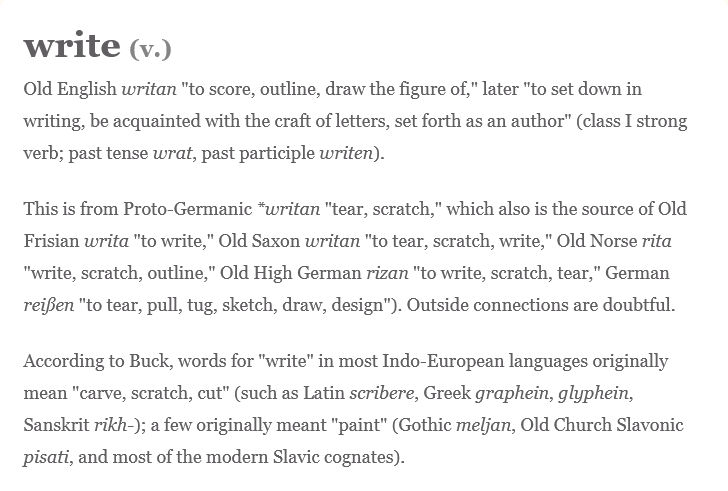
Writing can be like breathing – once you overthink it, it starts to freak you out. Culturally, writing is often romanticized, simultaneously reduced to some quaint, dismissable non-labor. Linguistically, writing is much more encompassing, both in the process it takes to record language and communicate with it in textual form, and also in the etymology of the word itself. To outline, to set down, to tear or scratch, to cut, to carve–writing can lay out the shape or design of things through elimination. Like carving, in removing what isn't essential, a new work and meaning is created. What isn't included can be as important as what is, transforming a block of wood or marble into a work of art. Writing is an expansive act, reaching across time and space to share a thought with someone you may never meet. Writing also sets limits. No one can ever 100% know exactly what you meant and writing removes spoken tools to communication: the pitch, tone, volume, inflection of a voice are not directly available in written works. The writer can infuse literary tone and voice into their works, but I suspect few would claim they work the same as tone and voice in spoken communication. Communication on the whole is difficult and, with the learning curve of new digital landscapes, often faces novel issues with technology developed well before we understand the implications of the new abilities and access it grants us.
As people, we often want to reach back to find some sense of stability. Sometimes this makes sense–if you're falling on suddenly unstable ground, reach for what you know to be safe. Culturally, this can lead to some wildly unsettling movements and a deeply frustrating dedication to nostalgia for misremembered history. Linguistically, though, it can be a playground for instrospection. If we trace "writing" far enough back (far enough that we must note these connections are often qualified with "might form" or "might be" the source or root of modern words), we end up at the reconstructed Proto-Indo-European (PIE) roots, such as “sker-" which gives us words such as share (n.), “portion of something belonging to an individual,” or share (v.), “to enjoy or suffer (something) with others...to divide one’s own and give part to other" or even "confess one’s sins openly."
People have written plenty about the act of writing, drawing poetic connections out of the nature of the work, breath, blood, carving, frantic animal struggle to communicate in the complex interwoven ecosystem of language and words. Perhaps part of the reason it is so easy to get tangled up in what to write or how to write or what I even have to say is that, being trained to see life as a series of finite tasks to complete efficiently and effectively, I have overlooked the fact that writing is not a discrete task, in any sense.
Writing is meant to be read by someone, even if only the author at a later date. Notes and to do lists aren't grand literary feats, but they are writing. The ways we record our thoughts into a revisitable, accessible form is inherently anticipating an audience, which is also perhaps why not wanting anyone to read something seemingly inevitably leads people to destroy the writing entirely by flame or blade or other obliterative means. And when it comes to more literary forms of writing, to write is to share part of your thoughts and feelings into the conversation that has been ongoing for generations.
It suddenly relieves significant pressure to output some great, impactful work when you recognize that you are not presenting to everyone on Earth, merely joining the conversation. Conversations can be effective without being efficient and sometimes the experience is the goal rather than some targeted outcome–think long chats with family or friends catching up on who did what when and where rather than work meetings with an agenda and time limit.
So in acknowledgement of all that has been written before and all that I don’t know how to write yet, perhaps I can finish (complete) this piece even if it feels unfinished (imperfect).